Leadership built through clarity, accountability, and trust.
This portfolio brings together the values, experiences, theories, and practices that shape how I lead and how I intend to grow.
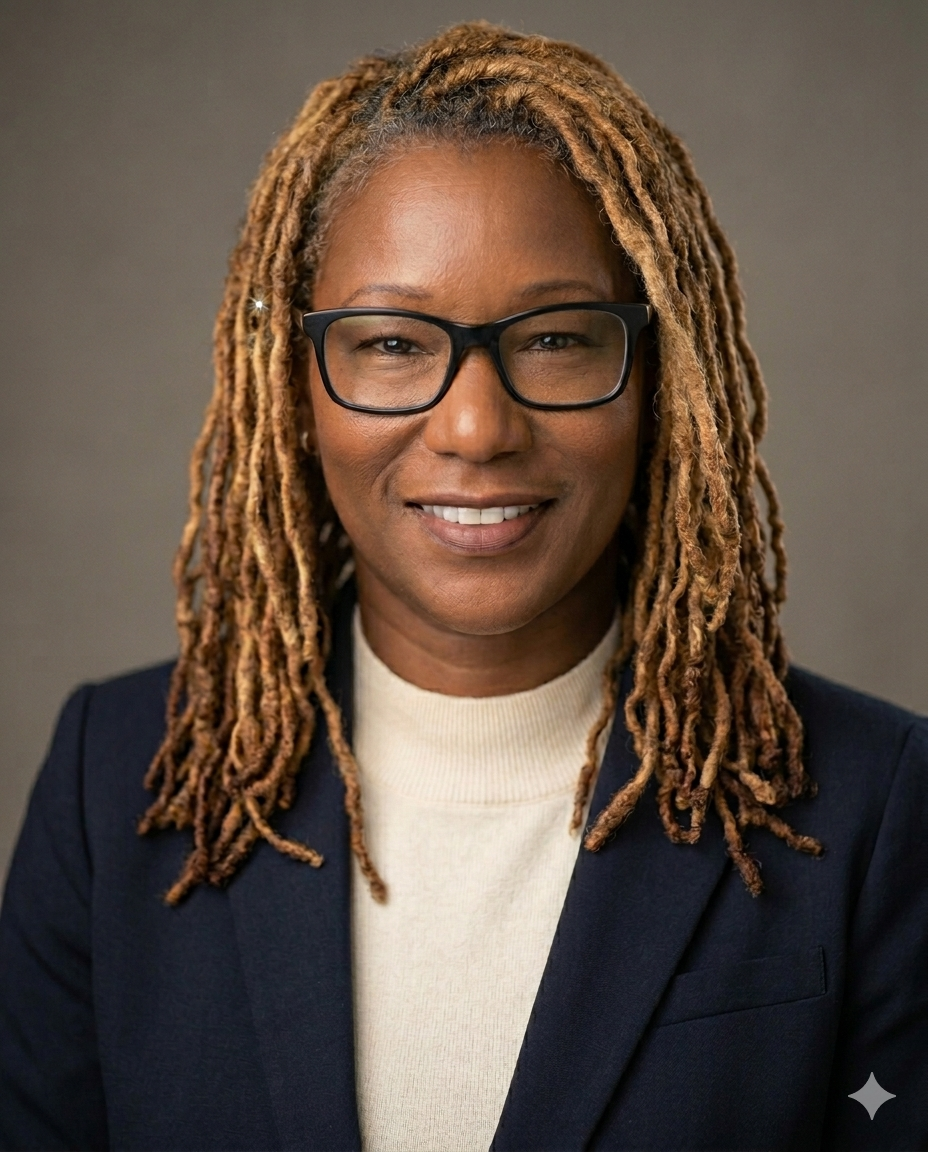
Leadership grounded in people and systems.
I am a strategic operations and governance professional completing a degree in Ethical Governance of Communication and Emerging Technology. My leadership approach centers on creating clarity, accountability, and trust within the systems people rely on.
This portfolio reflects the leadership concepts, personal experiences, and areas of growth that shaped my learning throughout the course. It also serves as a guide for the kind of leader I intend to become.
The values and experiences that shape how I lead
My leadership approach combines empathy, systems thinking, ethical judgment, and a strong instinct for creating clarity. The following strengths, values, theories, and influences provide the foundation for that approach.
My Strengths
Empathizer
I pay attention to how decisions land on people, not only how they look on paper. This helps me notice concerns early and build solutions people can actually live with.
Coach
I invest in the growth of the people around me. I would rather build someone’s capability than hold on to a task, because teams get stronger when knowledge is shared.
Believer
My values anchor my decisions. When priorities compete, I return to what I believe is right for the people affected, which keeps my leadership consistent under pressure.
Problem Solver
I am drawn to the gap between how things are supposed to work and how they actually work. I break complex problems into parts, find the root cause, and fix the system, not just the symptom.
Commander
I am willing to make the call and own it. In moments of ambiguity, I can name the decision that needs to be made, say the hard thing directly, and take responsibility for the outcome.
Core Values
Clarity
People deserve to understand what is expected of them, how decisions are made, and where they stand. I work to remove ambiguity before it becomes conflict, and I treat clear communication as a leadership responsibility rather than a courtesy.
Accountability
Every commitment should have an owner, and every decision should have someone willing to explain it. I hold myself to that standard first, which gives me the standing to expect it from others.
Trust
Trust is built through consistency between what leaders say and what they do. I guard it by keeping promises small enough to keep, being honest about limitations, and correcting mistakes openly.
Leadership Theories
The theories that most closely reflect my leadership
Transformational
Leadership is both who a person is and what that person does: knowing your values and strengths, communicating a meaningful vision, questioning ineffective practices, and creating conditions that enable others to act. It is a shared process, not authority exercised over people.
Servant
A leader’s first responsibility is to support people: remove unnecessary obstacles, listen with empathy, develop others, and build community. Success includes the well-being of the people doing the work, not only the mission.
Authentic
Self-awareness, an internal moral perspective, balanced consideration of different viewpoints, and relational transparency. Values such as dignity, fairness, and accountability must be visible in behavior and decisions, not just stated.
Together, these theories shape a leadership philosophy grounded in service, clarity, ethical responsibility, shared purpose, and trust (East, 2018).
Leadership Influences
The people and experiences that shaped how I lead
Two people in particular, a manager I worked for and a colleague I worked closely with, showed me different ways a leader can make people feel supported, capable, and accountable.
A manager who paired care with accountability
Working for this manager showed me that caring about people does not require lowering expectations or avoiding difficult conversations. That example shaped my belief that leaders should be direct, consistent, and willing to take responsibility while still recognizing the people behind the work.
A colleague who developed people intentionally
This colleague strengthened my desire to be the kind of leader who notices people’s abilities, provides meaningful guidance, and helps them understand how they can grow. Development should be intentional. People should not have to guess how they are performing, what opportunities are available to them, or whether their contributions are recognized.
The support I did not always receive
There were times in my career when I needed clearer feedback, more context around decisions, greater encouragement, or someone willing to help me recognize and communicate my own strengths. Those experiences taught me how isolating it can feel to navigate professional growth without enough support.
Leading the way I would have wanted to be led
I want people to understand what is expected, receive honest and useful feedback, have access to the information they need, and know that their development matters. I also want to recognize potential that is not yet fully visible, particularly in people who have not always had someone advocating for them.
Together, these influences shaped a leadership style that combines empathy, clarity, accountability, direct communication, and a genuine commitment to helping others grow.
To help create organizations where people can understand how decisions are made, know who is accountable, and trust the systems shaping their experiences.
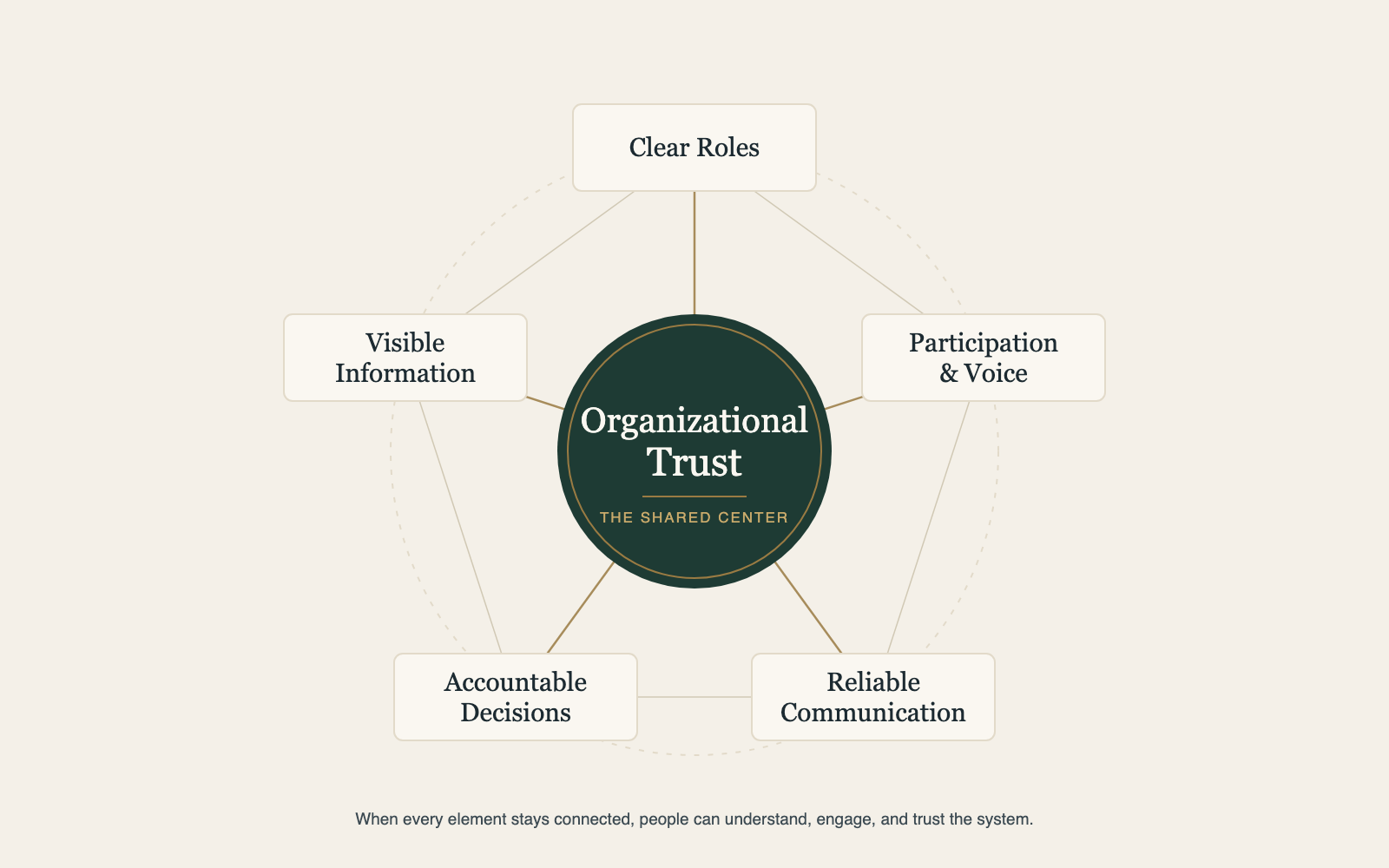
I chose this visual because its connected elements represent the structures that support organizational trust. Trust does not depend on one leader, one policy, or one statement. It develops through clear roles, visible information, accountable decisions, reliable communication, and meaningful opportunities for people to participate and raise concerns.
Each element supports the others. When one is missing, the whole system becomes less stable; when they stay connected, people can understand what is happening and engage with confidence. East describes vision as an image of a desired future that guides decisions and creates meaning (East, 2018).
Leadership requires awareness, humility, and action.
Cultural responsiveness means leading with the awareness that people experience the same workplace, policies, and decisions differently. The quality of a decision depends on whose realities were considered when it was made.
Leaders’ assumptions and blind spots shape organizations quietly. They determine who gets heard, whose concerns are treated as data, and whose are treated as complaints. Left unexamined, those patterns harden into systems that exclude people. Equity cannot rest on good intentions, so these are the three practices I commit to.
Listen before deciding
Before making decisions that affect others, I will seek out the perspectives of the people closest to the issue, especially those least likely to volunteer them, and treat what I hear as evidence rather than opinion.
Examine systems and outcomes
I will look past stated intentions and evaluate actual results: who benefits from a process, who carries the risk, and who may be excluded. When outcomes are uneven, the system gets examined, not the people.
Build accountability
I will attach goals, named responsibilities, measurement, and follow-up to inclusion commitments, so equity is tracked and reviewed like any other business priority instead of remaining a statement.
Teams work better when expectations and relationships are clear.
Clarity
Roles, priorities, decision rights, and expectations are visible to everyone. No one should have to guess what they own or who decides.
Participation
People have meaningful opportunities to contribute, question, and share expertise. A team that only hears from its loudest members is running below capacity.
Follow-through
Commitments have owners, deadlines, and a clear path for resolving problems. Follow-through is where team trust is either built or spent.
Innovation and Collaboration
Creating the conditions for people to contribute
Psychological safety
People need to feel safe enough to question assumptions, admit uncertainty, and raise concerns before small problems become serious failures. Safety does not mean the absence of disagreement. It means no one is humiliated or punished for disagreeing, asking for help, or acknowledging a mistake.
Honest, shared information
Open communication gives people a common understanding of the problem, the constraints, and the decisions already made. When information is fragmented, teams duplicate work and decide from different versions of reality.
Room to learn
Teams need opportunities to test ideas, evaluate results, and revise what does not work, supported by clear goals, accountability, dialogue, and reflective practice (East, 2018; Walter et al., 2017).
A responsible decision should be explainable to the people it affects.
My Process
Clarify the ethical issue.
Identify the people and stakeholders affected.
Examine values, responsibilities, bias, policies, and consequences.
Compare realistic options and risks.
Make, document, communicate, and review the decision.
An Ethical Dilemma in Practice
Reporting suspected environmental harm
The situation
An employee suspected that a chemical company was improperly disposing of hazardous waste containing dangerous “forever chemicals.” The concern was credible but unverifiable. Only an EPA investigation could confirm it.
The stakes
Reporting could prevent serious harm to employees, the community, and the environment. It could also damage an innocent company and the livelihoods of roughly seventy employees. Silence could let serious harm continue.
My decision
Report the concern honestly to the proper authority while clearly distinguishing reasonable suspicion from confirmed wrongdoing, and accurately explain the limits of what is known.
What it taught me
This approach respects everyone involved. The employee cannot control what the investigation finds, but can control whether the report is honest, responsible, and made through the proper process.
Waiting for complete proof would let serious misconduct continue in situations where employees lack the authority to investigate, while reporting every unsupported suspicion would be irresponsible. The ethical principle is to communicate reasonable concerns truthfully to the proper authority, consistent with Kant’s duty of honesty and respect for every person affected (Kant, 2017).
Making AI-enabled decisions more visible and accountable
The problem: in many organizations, AI tools are adopted faster than anyone can explain what they touch. Decisions and data flows shift without clear ownership, and the people affected, employees, customers, and leadership alike, cannot see how outcomes are being shaped.
The intended outcome of this plan is an organization where AI use is inventoried, owned, and reviewable, so that anyone affected by an AI-enabled decision can find out how it was made and who is accountable for it. Progress is evaluated through the completeness of the inventory, the presence of named owners, and regular reviews that confirm the records still match reality.
Assess
Identify where AI is already being used and what decisions or data may be affected.
Clarify
Assign ownership, document purposes, define boundaries, and identify escalation paths.
Build
Create practical review, documentation, communication, and oversight processes.
Maintain
Review the system regularly, update records, address new risks, and keep accountability active.
Creating trust through responsible AI leadership
The challenge I address in this speech is the growing use of artificial intelligence in decisions that affect people’s lives without enough transparency or accountability. AI may influence hiring, housing, health care, and public benefits, yet many organizations cannot explain where it is used, who is responsible for it, or how someone can question an AI-assisted decision.
My perspective comes from leading cross-functional projects where departments were working from different information. Documenting workflows and making information visible created shared understanding, and taught me that trust develops through the structures people experience each day. I want to bring that same approach to AI governance.
My call to action is simple: ask better questions. Where is AI being used? Who is accountable? Could the organization explain an AI-assisted decision to the person affected? My goal is to make innovation trustworthy.
What I Learned
Reflection on the elevator speech assignment
This project challenged me in a way I did not expect. Public speaking has never been one of my greatest strengths, and recording myself was the most uncomfortable part of the assignment. It was also where I learned the most.
Delivery is part of the message
Watching myself speak made me aware of pacing, eye contact, pauses, and how confident I appeared rather than how confident I felt. The feedback I received helped me treat delivery as part of the message, and adjusting it strengthened the final result.
Communication requires judgment
Narrowing AI governance, accountability, and trust into a message under three minutes meant deciding what the audience most needed, connecting it to personal experience, and ending with a clear call to action. Deep understanding has limited value when it cannot be communicated.
Confidence is built, not found
Each practice and re-recording made me more comfortable. By the final take I was focused on communicating the message, not on getting through it. Confidence comes from preparation, reflection, and a willingness to keep improving.
Clarity must extend to vision
Creating clarity is one of my strongest leadership instincts. This assignment showed me it must extend to how I communicate my vision. Trust depends not only on the systems a leader creates but on whether people understand the purpose and decisions behind them.
In future leadership and consulting roles, I will prepare with the audience in mind, identify the central message before adding detail, practice important presentations aloud, and seek feedback before final delivery. Public speaking can become another tool through which I create clarity, accountability, and trust.
How I intend to keep growing
I want to keep developing my communication, public speaking, ethical decision-making, and ability to lead people through change. In particular, I want to become more effective at explaining complex issues to people with different priorities and levels of technical knowledge, and to deepen my critical reflection beyond whether a project was completed: how decisions affected people, how power and culture shaped the process, and whether the systems I helped create were fair and accountable.
As I move toward my December 2026 graduation, my consulting work, professional roles, and independent research will give me opportunities to lead presentations, facilitate discussions, and seek intentional feedback from colleagues, mentors, and clients rather than waiting for it to be offered.
Most importantly, I want to maintain a regular practice of reflection: asking what worked, what did not, who was affected, and what I would do differently. Leadership development is an ongoing process of understanding oneself, learning from experience, and remaining open to correction (East, 2018).
References
Anthropic. (2026). Organizational trust as a connected system [AI-generated image created with Claude]. https://claude.ai
East, J. F. (2018). Transformational leadership for the helping professions: Engaging head, heart, and soul. Oxford University Press.
Kant, I. (2017). Groundwork for the metaphysic of morals (J. Bennett, Trans.).
Walter, A. W., Ruiz, Y., Tourse, R. W. C., Kress, H., Morningstar, B., MacArthur, B., & Daniels, A. (2017). Leadership matters: How hidden biases perpetuate institutional racism in organizations. Human Service Organizations: Management, Leadership & Governance, 41(3), 213–221. https://doi.org/10.1080/23303131.2016.1249584